
The Problem with Progress
Our technological gains have been astounding, but they haven’t come without costs.

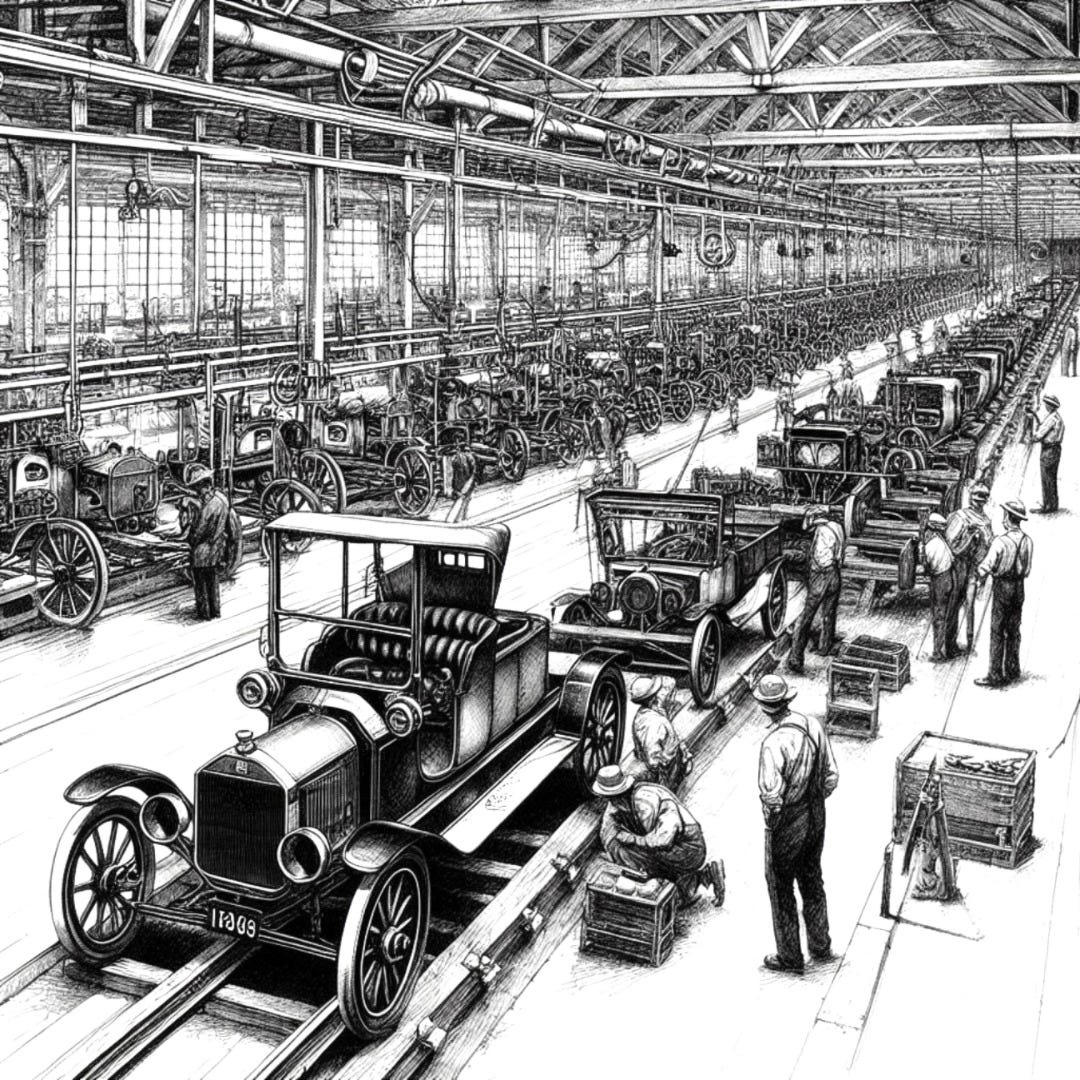
When Henry Ford built the first Model T in 1908, it satisfied two of his key goals: to create an automobile that was durable and also simple to operate. His third goal, however, was to be most significant. He wanted a car that would be affordable for the masses.
Pulling that off required what was perhaps his most important invention: the assembly line. It had its genesis in an idea some of his employees came up with — to build magnetos (the electric generator that sends current to the spark plugs) by having each worker add just a couple of parts and push the magneto down the line to the next guy.
Soon, he had developed the system that would transform manufacturing the world over. The item being built moved past workers via a conveyor system with each employee completing a single, repetitive task.
The results were dramatic. The price of a Model T dropped from $950 in 1909 to $360 in 1916 and to a rock-bottom $290 in 1926. Ford had his mass-market car and went on to sell 15 million of them.
Ford’s achievement is just one example of a myriad of similar developments from the beginnings of the industrial revolution to today. There has been an amazing flowering of technological innovation, ever driving in the same direction, giving us more stuff, at cheaper prices, more quickly, and often of better quality.
What is the ultimate end of this trajectory? Are we heading towards utopia?
The Solution of Humanity’s Most Basic Problem
John Maynard Keynes, one of the most important economists of the first half of the 20th century, was cautiously optimistic. Writing in 1930 at the outset of the depression, he felt the need to remind his contemporaries of the reasons to hope for the future.
In the essay, “Economic Possibilities for Our Grandchildren,” he notes how, after millennia of relative stability, humanity entered into a great phase of technological progress. Tracing the historical trendline forward 100 years, he expects that by 2030 or soon after, the problem that has been at the forefront of our collective mind since the dawn of history would be solved.
That problem is having enough to meet our basic needs. In other words, in the future the world would produce such an abundance that securing food, clothing, and shelter would no longer be a primary concern for most people.
The intervening decades have vindicated this prediction, particularly with the spectacular rise in the standard of living in some of the world’s most populous countries. India, for instance, has shifted from 63% of its population living below the international poverty line in 1974 to about 10% today. China has gone from 92% below the line in 1977 to less than 1% today. For much of the world, the problem of securing the necessities of life has been solved. In those places where the problem remains acute, poor governance is usually to blame — an obstacle for which, unfortunately, there is no easy technological solution.
Our Other Problem
Keynes recognized, however, that life is more than food and shelter and that the solution of the economic problem would give rise to another: “how to use his freedom from pressing economic cares, how to occupy the leisure, which science and compound interest will have won for him, to live wisely and agreeably and well.”
In his estimation, those of his generation who are the vanguard of the future, the wealthy who enjoy this freedom, don’t use it very well. Most of them, he writes, have “failed disastrously.”
On the other hand, he expects humanity will learn with time to steward our increasing freedom from want well:
“I feel sure that with a little more experience we shall use the new-found bounty of nature quite differently from the way in which the rich use it today, and will map out for ourselves a plan of life quite otherwise than theirs.”
Also looking ahead into a future of abundance and freedom from want, the creators of Pixar’s Wall-E take a more pessimistic view than Keynes. The film opens with an earth so covered in trash and waste as to be uninhabitable. Humanity continues its existence on the Axiom, a large cruise ship in space. Aboard, people consume their leisure in passive entertainments and bodily pleasures, glued to their screens and stuck in their beds, too obese and out of shape to walk.
So where are we heading? To Keynes’s future where abundance empowers well-lived lives or Pixar’s, where the bow of human vitality is unstrung and economic liberation simply enables an atomized existence in front of our screens?
Things Lost
There is a lot to be said for Pixar’s vision. A key problem is that many of the developments that give us more, cheaper, and faster involve tradeoffs that seem to militate against quality of life in other ways.
I recently visited the Henry Ford, a vast museum of industry that catalogs the development of the assembly line (among many other similar developments). I was struck by something revealed by one of the exhibits. When Ford introduced his assembly line, he suddenly found himself with an acute problem of worker turnover. The new system was great for efficiency, but it transformed what had been a relatively interesting task of assembling an automobile into the absolute drudgery of placing part A onto sprocket B twice per minute, all day, every day.
Ford solved the problem of worker retention by sharply increasing pay, but it is an open question whether workers were ultimately better off.
We can discern other examples of similar tradeoffs everywhere we look as technological advances have transformed our lives. As Neil Postman describes it in his 1985 book Amusing Ourselves to Death, the advent of television has given us access to media more easily and cheaply than ever before, but simultaneously degraded the depth and quality of our discourse in areas ranging from politics to religion. One need only compare the famous Lincoln-Douglas debates on the eve of the Civil War, where an audience of average citizens listened intently to several hours of complex discussion, to recent presidential debates where candidates are given a minute or so to pronounce slogans and trade silly jabs.
Food is cheap and abundant, but obesity has reached epidemic levels. Transportation has enabled mobility and we’ve lost community. Entertainment is available in our homes and we’ve stopped leaving them to engage with others. Social media makes connection simple and instantaneous and we’re lonelier than ever.
The problem is that we seem to be trading off the most important things in life for the least important. One of the conclusions of the world’s longest-running and most comprehensive study of human happiness, the Harvard Study, is that deep and abiding relationships are the most significant contributor to it. Though the connections are not always straightforward or easy to see, it is clear that the way of life in the modern world is making it increasingly difficult to form and maintain such relationships.
To cite just one example, the time those between the ages of 15 and 24 spend in person with friends has plummeted 70% over the past two decades. Most commentators attribute this drop to a change in technology: the rise of smartphones and social media.
This is simply the latest data point in a trend that has been visible for decades. People are having fewer and weaker social connections.
Taking a more comprehensive view of how we’re doing, we can see that our mental health is abysmal.
Perhaps having more, better, faster, and cheaper isn’t worth the trade.
Choosing Life
Even if we see the problem clearly, it is difficult to know what to do.
One difficulty is that we do not collectively decide whether to adopt a technological change, weighing the costs and the benefits. Rather, some person or company creates something cheaper, faster, and better, market forces drive its adoption, and the rest of us are slowly compelled to make the trade, whether it is a good one or not. More often than not, this is because the older ways of doing things become economically non-viable. Any of Ford’s competitors, for instance, who didn’t adopt the assembly line were soon put out of business.
Moreover, there doesn’t seem to be any practical way to arrest technological change, the pace of which accelerates by the year. This is particularly true in a global economy where companies within multiple countries are constantly searching for a competitive advantage.
Even when there seems to be a way to limit forward motion to preserve something good, doing so can amount to the better off denying the benefits they have enjoyed to the poorer. This happens, for instance, when a town successfully thwarts the opening of a Walmart to preserve the color and character of local businesses. It’s great to be able to browse quaint downtown shops to buy expensive merchandise when you have money. For those with less, Walmart means being able to get a bit more breathing room in the budget.
Nevertheless, we are not completely helpless in the face of change that is eroding our quality of life. We don’t have to simply be carried along by the momentum of what is done around us. Instead, we can make choices based upon the metrics that really matter.
For example, we can choose to intentionally invest in relationships and prioritize them in how we spend our time. This is hard because it often involves doing something more difficult now in order to reap a benefit later. Whereas the way of life in previous generations naturally created contexts for relationships, now we need to go out of our way to cultivate them.
In a town in which I used to live, I met with a small group of other men once a week for around four years. There were certainly times I didn’t feel like getting up early to join them and there were always other demands on my time, but that fellowship gradually grew to be one of the most valuable elements of life — a place to know and be known, sharing the ups and downs of living. There is no shortcut to such things.
As another possible example, we might swap out our smartphone for a dumb one and regain the habit of being more present to our surroundings and the people we are with. Or we might leave a higher-paying job for a more enjoyable and fulfilling one.
We have gotten to where we are today by the relentless pursuit of more, faster, cheaper. Our success in this endeavor threatens to stunt our humanity, like the passengers on the Axiom, with our stomachs full but our souls starving for the deeper things of life.
Maybe less leads to greater simplicity, heightened gratitude for what we have, and more time for relationships. Maybe slower encourages enjoyment and attentiveness to the present as opposed to an anxious hurry and preoccupation with tomorrow. It’s still possible within the confines of modern life to shift our habits and prioritize the things that make for living well. Why not try?
I spend more time with live people instead of electronic stuff!
John,
It's interesting how you mention how technology has reduced poverty yet what I'm hearing in my part of the United States is prices going up and not enough income to pay necessities like rent and food. Yes, we are better off with cars and things many parts of the world don't have but technology usage can help or twart human flourishing. If we only use technology to feed ourselves entertainment and confine ourselves into isolation we will be lonely. It is noticeable to me that even my age group, the elderly, have cell phones but they Choose not to answer texts, calls, emails until it is convenient to THEM. Even my coffee group do not treasure or protect our meeting time by showing up on time, keeping the time open for relationship events. I personally think greed and selfishness have resulted in isolation more than technology. There are many things that need human hands to improve such as visitations to the truly sick and home bound but we are opting out of helping make the world better. It's not a natural thing to replace leisure and fun with mingling with the masses. Sandy